
Comprehend It Not

The class of 1996 was the first graduation in three years that wasn’t going to be done over tele-vid. I was lucky. I thought about this while I watched Lucy give her grandpa the first injection of the month. It was in the back of his neck, a little spot near the shoulders that was hard to do yourself, and she placed the auto-injector with practiced ease. She did it with a chuckle at one of his jokes.
“I would’ve missed three times already,” he was saying, lifting a shaky hand. “That’s why I always buy three injections—you know, just in case.”
“Don’t think that’s entirely healthy, Grandpa,” said Lucy, setting aside the injector after a moment. She was in the living room of her family’s spacious two-storey, a house just down the road from mine. She’d always been here, as long as I could remember, and it was difficult to imagine going to school without seeing her smile from across the street. When she saw me enter, she gave it to me again: that smile like sunshine haloed by the golden blonde of her hair. She was my best friend and, I’d hoped, maybe something more after that day.
But someone else was already here. I’d seen him arrive just before me, and he stood in the living room with his own smile. This was Isaac, a handsome, dark-haired boy the same age as us. He’d been my friend almost as long, and Lucy’s friend even longer. He seemed to consider sitting down next, after Grandpa left the seat, but he hesitated.
“Hey,” said Lucy, this time to me. “You made it. Figured I’d get the stick done first, then we can head out. Still got plenty of time.” I nodded, but hesitated again. Which one of us was first? Isaac or me? At length, Lucy seemed to decide between us, then motioned for Isaac. I suppressed a sigh. “Let’s get yours done, Izzy,” she said. He took a seat.
“Heard these new ones are supposed to last twice as long,” Isaac said as he bared his neck for her. “Keeps the latent pool under control better.”
“Yeah, it’s supposed to,” Lucy agreed cautiously. “But if the dormant cells don’t produce enough antigen, it won’t really matter. I’m in favour of better boosters, fewer injections. Let’s just hope this one actually is better.”
“I’ll check the antibody titre later, see if the measurements are any better. Can’t hurt to do a little of our own research, huh?”
“Can’t hurt,” Lucy agreed. She injected him the same way she had Grandpa, but I was too busy gawking to really notice it was my turn. The two of them waxed scientific for a few moments longer, discussing whether this new wave of boosters would be effective, and whether or not some nearby districts would lift their pandemic measures as a result. Most of it was lost on me. Isaac and Lucy always had a connection that way. If the three of us were together, you could safely bet I’d be sitting awkwardly to the side, at least half the time, while they discussed some concept way beyond my understanding. They were both graduating with honours that year, both set up with scholarships, and both in line for some kind of biology degree.
“All right, Izzy, let him have his turn,” Lucy said at length. It had been a few minutes. She waved me over, and I took the seat left vacant. I felt like I should say something, engage her somehow, but I didn’t know what to say. “You excited?” she asked at length.
“What, for the ceremony?” I asked.
“That, and everything after. I mean, it’s… our whole lives.”
“Yeah,” I said at length, though I sounded uncertain. Truth is, I was uncertain. But who wouldn’t be? “Thinking about going for a philosophy degree,” I told her. “I’m not as book-smart as you two, but…”
“You’re smart in your own way,” she assured me. “Don’t worry. I can’t usually keep up when you rant about epistemology or something.” She braced my neck.
I almost blushed at the comment. “Thanks, Luce,” I said. “I dunno about smart, but thanks. It’s a passion, either way. Maybe I’ll specialize in something, become a professor.”
“You’d make a great one,” she said. There was a warmth in her voice, but also something else I couldn’t quite make out. Either way, she hesitated. I didn’t feel the sting of the injector. I wondered why. But a moment later came the sting, then it was over.
I stood up, rubbing the back of my neck, and asked, “Want me to do yours?”
She shook her head, and I hid my disappointment. “Did mine already,” said she. “Don’t worry about it. I think…” She checked her watch. “We should get going. Ceremony’s not gonna wait on us, and we don’t have much time left.”
We left her house beneath the bloody-orange of a setting sun and piled into her car. I took the back seat, Isaac the passenger seat. Lucy always seemed to favour him just a little. Grandpa came too, but the rest of Lucy’s family would be showing up later with mine. It was our last day before freedom. We wanted to face it on our own. Grandpa insisted on keeping us quiet company.
We spoke for a while during the ride, and it was a good way of taking my mind off the ache at the back of my neck or the minor fever that usually followed a booster. School was fifteen minutes away, but traffic was light and the way ahead was clear. “There was a farm there, in my day,” said Grandpa, gesturing out the backseat window next to me. “And none of those apartments were standing. Clear view, all the way to the river.” I watched the jagged mountains of concrete with a certain puzzlement. It was difficult to imagine a time before my childhood, before my town as I understood it to be. “Took me over half an hour to walk to school,” he continued, chuckling. “But I looked forward to it. You kids don’t know the difference, driving like you do.”
“Air must’ve been cleaner, too,” Isaac added. “Fewer cars on the road.”
“Not as much as you’d think,” Lucy countered. “Depends what kinda cars we’re talking about. The loud, polluting, and generally unsafe cars of back then are not something I’d envy. Not much better now, to be honest, even if they have improved.”
“But hey,” I said, “at least they have improved. Could be worse.” Lucy said nothing, but I caught her eye in the rearview mirror all the same. There was a sharpness there, but I didn’t know what it meant.
“Think I’ll take environmental science as a minor,” Isaac said next. “I’m sure cars could be improved even more if I set my mind to it. I’ve always found land and ecosystems fascinating together, anyway.”
“Please,” said Lucy, chuckling. “I remember how you did in Geography. Don’t embarrass yourself, Izzy.”
“Hey,” Isaac started, also chuckling. “Wasn’t asking you, Luce. C’s get degrees, as they say.”
“Well, that gives me hope,” I added, though my chuckle was more uncertain.
“You’ll be fine,” Lucy said, offering a smile. But it wasn’t the same smile I was used to—it was a little crooked, a little melancholic, and it puzzled me. “I’m not sure I really see the point in university, anyway.”
“What do you mean?” Isaac asked. “You’re not throwing away your scholarship, are you? Besides, imagine all the work we could do if we put our heads together! I don’t want to be getting my degree alone, Luce.”
“I just…” Lucy hesitated, perhaps looking for the words. “I just think people are more concerned with prestige than actually solving problems. When it comes to doing the hard stuff, people usually take the easy way out.”
“Oh, c’mon,” said Isaac. “You don’t really believe that, do you?”
Lucy said nothing, keeping her eyes on the road. Isaac looked at me, as if he expected backup. I chose my words carefully. “Who knows?” I started. “Maybe she’s right. But that doesn’t have to be us. You two could make excellent scientists, change the world. Me, I just want to do something meaningful. Learn, figure out my place in the world, live my life well. Abstract, I know, but it’s one of those things you can’t really capture in words. You just have to live it.”
“Sounds more realistic,” Lucy said, smiling at me.
“Oh, Lucy,” said Grandpa next. “Look there!” And he gestured to a playground, rusted and worn with age and overuse. There was a temporary fence around it and a sign that said under construction. “Remember when I used to take you there? Push you on the little swing set?”
Lucy smiled, but seemed to hide it.
“I remember, Grandpa.”
“And look at you now,” he continued, “so grown up. Smarter than I ever was. I’m proud of you, girl.”
“Thanks, Grandpa.” We passed the playground by. She sighed. “Won’t matter much longer, though.”
“The playground?” he asked.
She hesitated.
“Yeah. They’re demolishing it in a week or two.”
“It’s just change, girl. Natural. Nothing lasts forever.”
“No,” she said. “I guess it doesn’t.”
“My grandfather told me the same thing when I was your age. He’d point to all the places that changed, all the new houses or empty plots, and he remembered. We mourn what we lose and appreciate what we get. That’s life, Lucy.”
“Give it time. There won’t be much left to mourn.”
“What’s gotten into you?” Isaac asked, scoffing. “Ceremony stressing you out?” She shrugged but offered no reply, so he glanced out his window. “Look at that,” he said, pointing to a different plot of land. A large building was under construction, and it was set to be one of the largest apartment buildings in town. My home was transforming into a city, slowly but surely. “Bet that’s going to be pretty sweet when it’s done,” he continued. “What this town needs is a bit of modern engineering. Look, the old pandemic stuff is coming down, too.” Barrier fences here and there had been torn down, old social-distancing marks on the ground no longer served a purpose, and a fresh bus stop had just been put up nearby. A couple of temporary buildings for booster distribution were no longer needed, and they’d soon come down to make room for something permanent. Something new.
“Think that new transit station will be an improvement, as well,” Isaac said.
“You know what used to stand there?” Lucy said. “Where they’re putting the station up? An old-growth forest. You can bet they didn’t relocate any trees when they cut their way in there.”
“But it’s an improvement for the town,” Isaac countered.
“And a loss for everything else.” Isaac frowned, but she continued: “We’re becoming a city. Great. What do you think caused the pandemic in the first place? Too many people all in one place and a careless scientist with a Petri dish.”
“That’s a grim way to look at it, Luce,” Isaac said at length.
“Call it what you want,” she answered. “I just call it realistic. People don’t change. Life doesn’t change. It’s just the scenery.”
We all fell silent as we drove up to the school grounds. It was a huge, aged building that hadn’t been updated since Grandpa’s time, but it was plastered in the remnants of the new. Murals stretched along the columns at the entrance, a few beaten coupes in the parking lot sat alongside slick new hybrids, and a tower across the river, in a neighbouring city, stood tall enough to peek over the top of the school and peer down at us. One of the murals depicted a boy and his dog about to step over a bank into a river. Another was a woman pouring a pitcher of water into a pond of starlight. The first was dated 2000; the next, 2017. I always preferred the first one. The sun had nearly set, and the clouds were cast in crimson. We got out of the car and I swallowed.
The metallic taste of the booster still sat at the back of my mouth.
My head started to hurt the second we walked inside. It was crowded, but this wasn’t the reason. Headaches were among the rarer side effects of the boosters, so I sighed and tolerated it. Isaac registered first, then departed to meet his family, so I stayed with Grandpa while Lucy went to meet her own family. My family was late, but I didn’t think much of it at the time. I thought instead about what Lucy had said. Could she be right? Was it really that bad out there, in the world? We were in the gym, at the threshold of the rest of our lives, and we needed only to walk onto the stage, receive our papers, and walk out that door.
But something was wrong. It was partly in the headache that was making me wince, and partly in my company. Grandpa, sitting next to me at a table, was in the midst of a story. “We did our ceremony outside,” he was saying. “It wasn’t snowing that day, though. Down by the river, we…w-we…” He stammered, felt his throat, then pressed a hand to his forehead. I watched him, too shocked to move, as he pitched over to one side and hit his head on the table, then stayed there unmoving. I leapt up, hesitating a moment, before I lunged for him and tried to shake him awake. But he didn’t react, and a hand on his throat found no pulse.
“It’s okay,” said Lucy, who had approached from behind me.
“Luce!” I exclaimed. “Quick, your grandpa, he’s—”
“I know.”
“Th-Then do something! I don’t know what’s… what’s going…” I gripped my head as the throb intensified, and my throat suddenly felt tight. When I looked at her again, her expression had no sunshine left. “What’s happening?” I asked.
“Only what has to,” she answered. “I don’t think you’ll understand.”
I backed up, looked around, and tried to force out a cry for help, only for another cry to steal my attention first. Across the room, the crowd gasped and screamed, parting suddenly for a smaller group on one side. It was a family, the mother of which was kneeling over the still body of her son. Even from here, I could tell who it was: Isaac. My heart leapt up behind my teeth.
“Lucy…” I started. “What did you do?”
“This isn’t a booster,” she said, holding the injector out in front of me. “But it will ensure you never get sick again.”
“You… y-you didn’t…”
“You won’t understand. That’s okay. All you need to know is this: Grandpa had about twenty minutes, Isaac about twenty-two. You have a little more than five left.” She readied the injector over her neck. “And I’ll have a little more than twenty-three.” But I lunged for her before she could do anything more. How could she do this to me? To all of us? I took the injector and pressed it hard into the back of her neck. She flinched, but didn’t move. When I stepped back, there was no satisfaction in her face, no fear or anger, just resignation. I looked at the injector in my hand, then let it fall.
“I saved you for last,” she said.
“Why? W-Why did you do this?”
“You won’t understand.”
“I deserve to know!” I sobbed. “Lucy, you killed them! Grandpa! Isaac!” I clutched my throat. “M-Me…”
“And you killed me,” she pointed out. “It’s a mercy. C’mon. I don’t want you to die here. Let’s go to our spot.”
I wanted to object, but she left without another word and I had no other choice. The crowd was an assembly of shadows, faceless, murmuring shapes that drew around the still body of Isaac and obscured it from view. I followed Lucy past the shadows, none of which were aware of the next death about to take place. We exited to the field and trudged through the snow, making our way to the river as quickly as we could. The sky was clear, the moon full, and the winds strong. The tower loomed in the distance, its top unfinished. The moonlight seemed to slice it at an angle. There was a tree here, too, with the letters L + D above the Roman numeral XX.
“The world is sick,” Lucy continued. “The pandemic is just one symptom. Everywhere you look, there are symptoms. The cause has always been deeper than that.”
“What the hell do you mean?”
“Don’t you get it? It’s this world. It’s the people in it. Life devours you whole, and you spend your time making it that much worse for the next person in line. All people ever do is make things worse. It’s people who ravage the planet, people who wage wars, and people who start pandemics.”
“But it’s also people who stop those things,” I said.
“Wouldn’t need stopping in the first place if it wasn’t for us.”
“So, what? That means you get to decide who lives or dies?”
“It’s a mercy, Daniel. This world doesn’t deserve us.”
We stopped at the river’s edge and I rounded on her. “You don’t get to decide that! Not for me, not for Isaac, not for your grandpa! Who gave you the right?”
“If not me,” she said, shrugging, “then who?”
“What happened to you?” I asked, small now.
“I opened my eyes.” I gaped, but had no reply, so she continued: “It’s obvious if you really look, Daniel. All people do is fail. Don’t you think it would be better if we didn’t live in this world at all? This world full of malice, and cruelty, and self-interest? You want to know why I did it?” She took my hands into hers. “Because I can’t stand, for one more second, waiting for this world to swallow you whole.”
I pulled my hands away. “I had a life,” I started. “I… I was going to do something with it.”
“And you would’ve failed,” she said, compassionate like a serpent. “It would’ve ground you down, day by day, until all you could do was beg for it to be over. That’s what this life does. When everything is shit, and is always going to be shit, why bother? I’ve made it simple for you: You don’t have to bother. In a few minutes, nothing will bother you ever again.”
I looked away, at the tower, at the water, and felt a pressure rising in my chest. Maybe it was a heart attack. All I knew was my time was coming quick. But she was wrong. I knew she was. “You talk about taking the easy way,” I started, “but what are you doing?” When she blinked and considered, I pressed harder: “Fighting for something would’ve been hard. Giving me and Isaac a chance would’ve been hard. Living this life would’ve been hard. But what did you do? You chose to give up. Take the easy way out. And you chose to take me with you, whether I wanted it or not.”
“I’m saving you!” she exclaimed. “Think about all the hardship, all the pain, all the—”
“Think about all the joy you’re robbing me of!” I interrupted. “All the success, the stories, the experiences! Yes, Lucy, I would’ve failed! And then I would’ve dusted myself off and tried again!” I stifled a sob, then looked her in the eye. “Just because we fail doesn’t mean we can’t do right. Yes, people ravage the planet and destroy each other. But when we make a mistake, we fix it. Or did you conveniently forget the last five years?”
“It’s just one step in the same old cycle,” she countered. “It’ll happen again and it won’t get better.”
“Maybe it will happen again,” I admitted. “Maybe human selfishness will plague us to the end of time. But that doesn’t give you the right to judge the world unworthy. I wanted to live. I had plans. You… you had so much potential. But instead of using your gifts, you decided none of us deserved them. Instead of doing what was difficult and necessary, you gave up.”
“No,” Lucy started, uncertain this time. “No, you just don’t see it. No one does. Not Grandpa, not Isaac, not you. Only I see it. That’s why I had to make the choice.” A look came to her eye then, a glare almost like hurt, and I’d seen it only once before. “You’re no better than any of us, Daniel,” she said. “You killed me too.”
I felt my throat constrict. I didn’t have much time. But, in a way, that made things simple. There was only one thing I had left to do. “Yeah,” I said. “I was angry. It was wrong, and I wish I hadn’t. I’m sorry, but I can’t take it back.”
“Then don’t you see?” she asked. “Don’t you see what I mean?”
I approached the water’s edge, watched the dark current below, then looked up to the sky. The river kept moving. The stars were bright in the firmament. “I see it,” I answered. “You see it. Your problem is you don’t understand it.”
“Oh, no?”
“What I did proves you wrong, Lucy.”
“You did exactly what I expected you would.”
“And then I realized I should’ve done better.”
“But you didn’t.”
“But I could’ve. And that’s the difference.”
“What does it matter? You chose destruction.”
“It matters because it proves I’m capable of more than that.” She eyed me incredulously, but I didn’t back down. “You’re smart, Luce. But you’re not omniscient. You see what people do, the patterns that make up our lives, and you think you see the whole picture. You think you know enough. You think you’re doing what has to be done.” My look became a glare. “But you’re really just selfish.”
She flinched. “Selfish?” she said. “I did all of this for you!”
“No, you did it for you, Lucy. You did it because you couldn’t stand to watch me live. So you’d rather have me die.” I scoffed. “And you justified it afterward. Because you’re Lucy, and you know everything.” There was silence for a long moment, but I didn’t look at her again. I looked at the sky, and the stars sparkled in the firmament. “I almost wish I didn’t love you too,” I said at last. “But loving me didn’t make my life yours to take.” I felt a shudder in my chest, and the throb in my head reached a terrible apex. It wouldn’t be much longer. “I wish it didn’t go this way, but…” I glanced at her, and there were tears in her eyes when they met mine. “There’s no point in being angry now. If I see you again, one day, I—”
My heart lurched and choked on the words. A horrible, stabbing pain found my chest and my balance left me. I think I fell. I think Lucy caught me. Either way, she was above me when I came to rest in the snow. Her head was silhouetted against the stars, but it was as if the stars themselves retreated from it. My vision started to tunnel. But I wouldn’t go just yet. I had one more thing to say.
“You were wrong,” I managed. I reached for her until I found her cheek. “You made… a mistake. It’s not too late… to admit it.” When she looked at me, uncertain, I managed a final gasp for breath. “I forgive you.”
I waited, watched her lips move in imitation of sound, but she could only stare. Maybe she went to say something. Maybe she made another mistake. I didn’t know, because the darkness encroached until I could only see stars. I died in Lucy’s arms, and I never knew her reply.
But she stayed where she was for a time longer. She held me as my heart stopped and the light left my eyes. And her lips again tried to find the words. But she said nothing. She stared. She stared until her gaze became a glare, a tear boiling in a crucible, and only shadows filled her eyes. No, she thought. She had it right. She must’ve had it right. She had seen the truth, she knew it completely, and no one could tell her otherwise. She didn’t need my forgiveness. For she was Lucy.
And Lucy was always right.
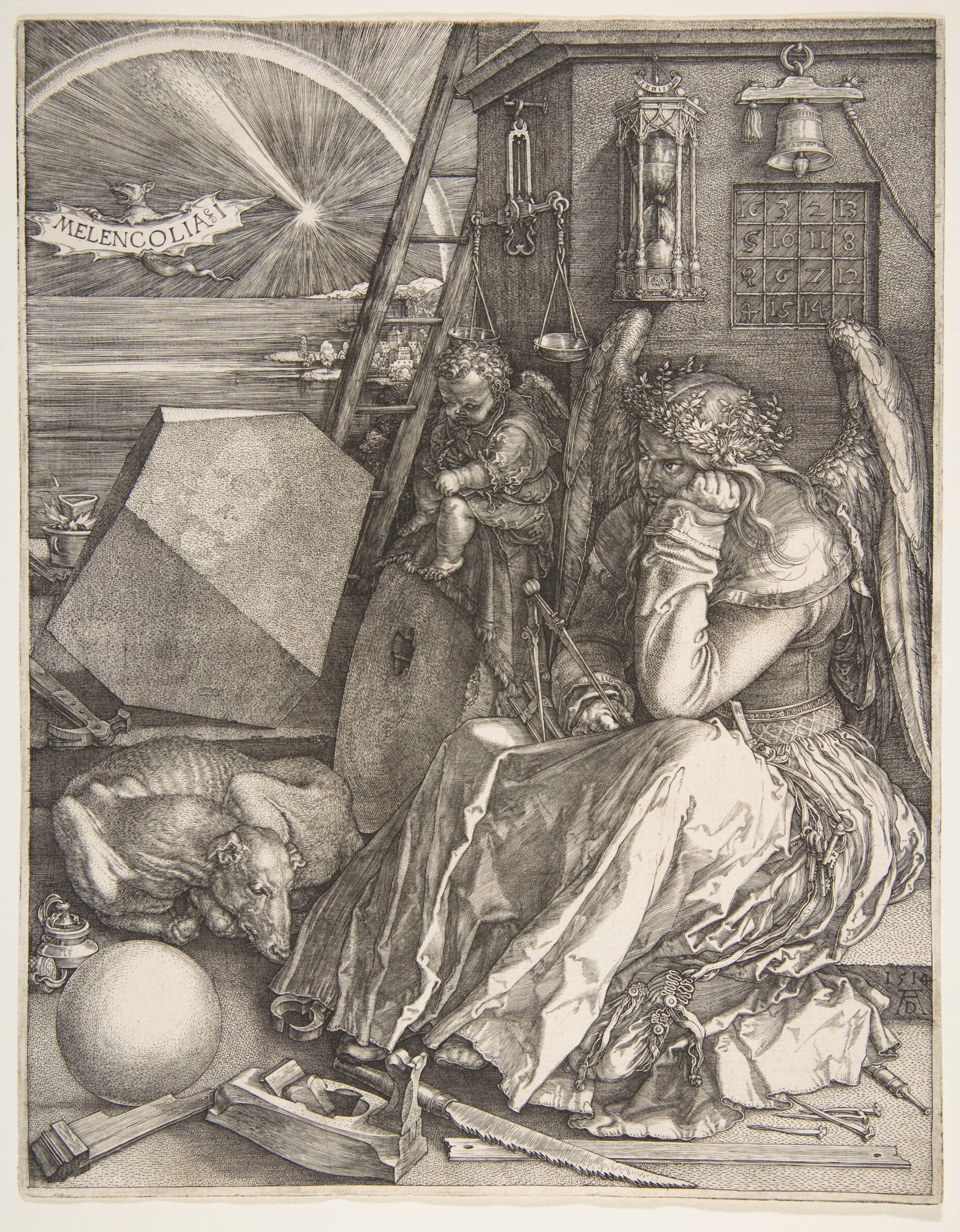
- Albrecht Dürer’s “Melencolia”
Lucy? Lucifer, perhaps? The call of resignation and self-destruction dressed as love. I think Daniel’s decision to inject her back and their following conversation on what he could have done instead speaks volumes on the ethical dilemma in question, that taking life from others is a natural response to having life taken from oneself. We can only hope humanity breaks the cycle.
This story hit me hard. There is sadness at the loss of potential because of the destructive, hopeless action of the one. Ugh. If reincarnation could be part of that story, I would hope for Daniel's soul to come back and experience that optimistic outlook to its fullest and be the light in the darkness for others.