Worldline Acrimony
A bloody thriller at the end of the world.

ONE
FOUR FRAGMENTS
This in atramentous Black begins
a thousand other shades within
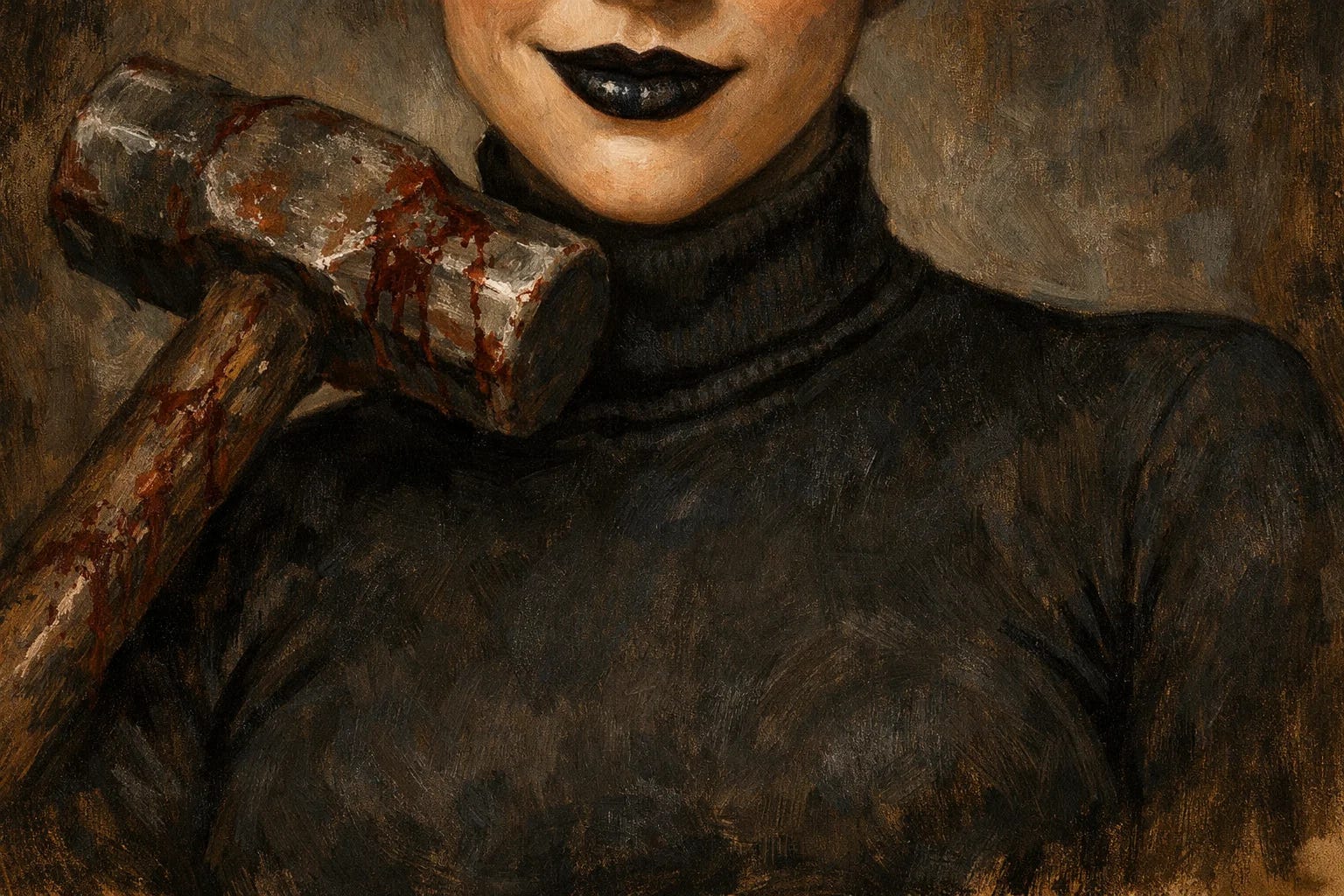
Her signature was a sledgehammer embedded in a cranial concavity, and she signed her work with eager alacrity. A body dropped with the impact and fell at her feet, spattered in blood from the wound which still wept across her side. She was Verse, and her name meant a line that cut; across fates and paths, streets and alleys; across throats and plots, foes and allies; and always across everyone and everything that ever intersected her bloody worldline. She wondered then, as she often did, if there were a million other fractals of her in different worlds, doing things just differently enough to be alternative, and if, when this plot ended, she might travel to the next. She was a poem of one line, written in hammered scarlet and stained in gunpowder, dressed in a tight black sweater and torn jeans, girded in leather boots and ballistic weave, hidden behind a mask that looked like Black and eyeless death and left her mouth exposed enough to grin with lips painted dark. She was Verse, the spectre of death itself, and she was dying.
She knew this as she gripped her side and felt the blood rush past her fingers, over black-painted nails and crisscrossing scars; she knew this as her legs weakened and her breaths came short. But she grinned and hefted her sledgehammer onto a shoulder, then left her wound to bleed and fished for a cigarette. There wouldn’t be another line, she thought; not for her. It was a universe for a reason, and this encapsulated her perfectly. So there was nothing left to do but run—not flee, but charge. Smoke billowing from her mouth, she retrieved her pistol from where it had fallen and looked to the blood-spattered trail which led ahead of her. She was in a dark chamber in a network of holes and corridors much alike—a network which ran through her city like a labyrinthine abattoir. In this place, in this age, on the final day of 1999, there was nothing left but this. Nothing left but her. Nothing left but her prey.
And so she strode, grimaced, and puffed from her stick of aerosolized death. There was still one more who had escaped her, still one who had not felt her hammer or tasted her lead. And he would not get away.
A laughing Yellow thing returns
resounding ever onward spurred
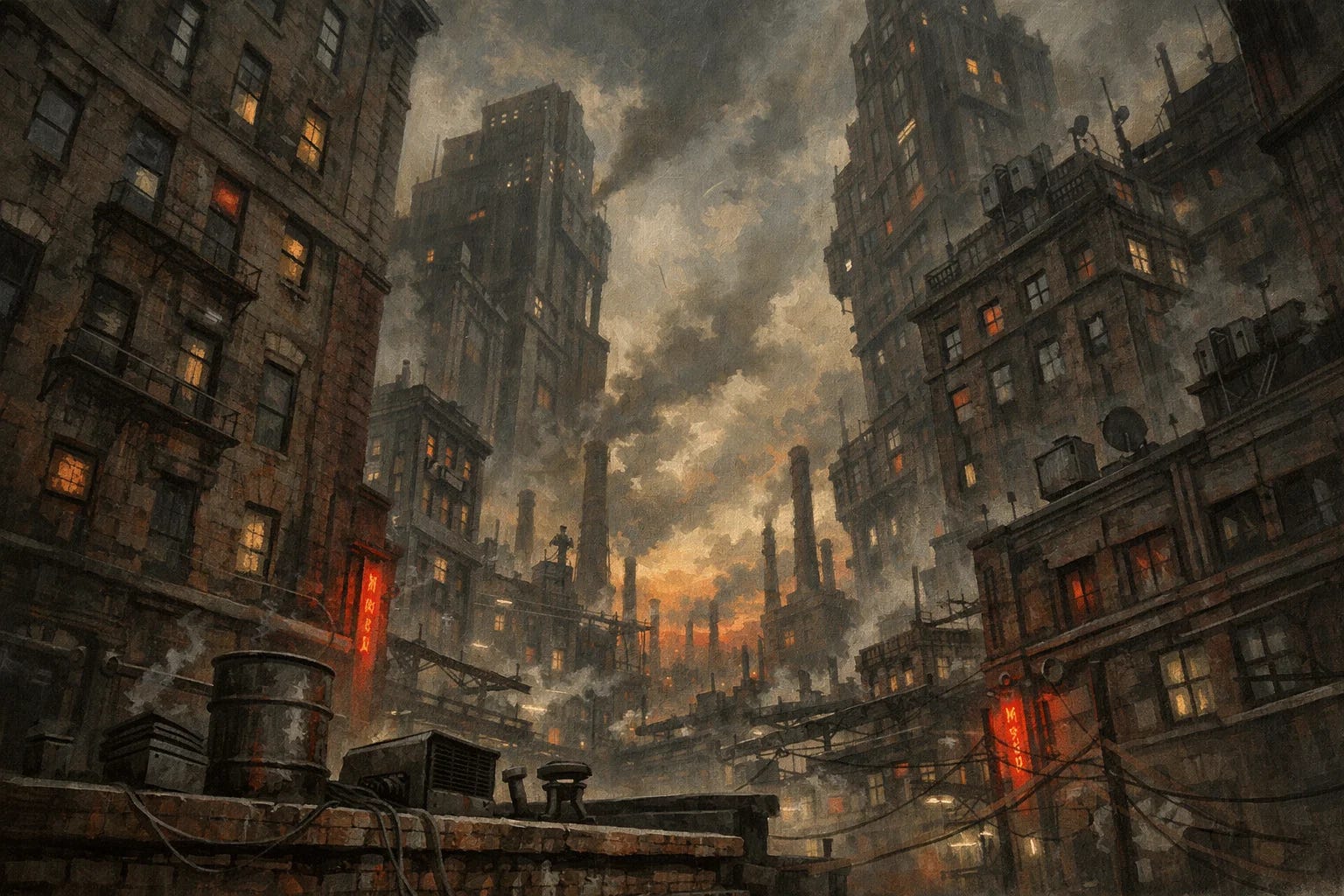
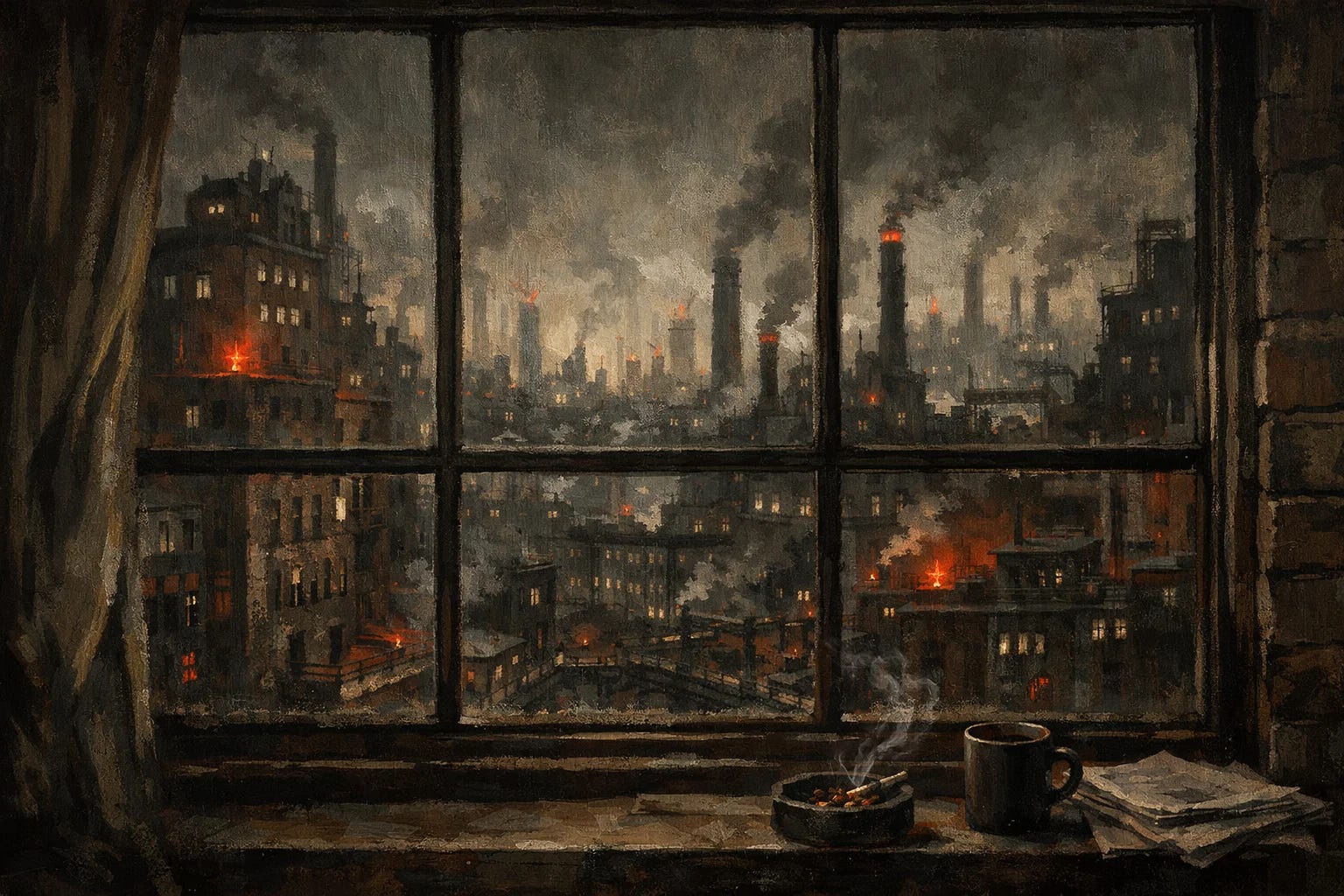
Verse bathed in roiling agony and embraced it like a balm, chuckling all the while. For pain was all she knew, and it made for excellent company. In pain she kept focus, in agony she was grounded, and as a final contraction of well-toned arms brought her chin passed the door frame once more, she groaned and let herself fall to her feet. Her arms burned, her back stung, her latest injuries—not fully healed—bleeding anew across pumped biceps and scarred knuckles. But she ignored them and let her eye remain fixed on the smog-stricken skyline which followed the crooked silhouettes of ten thousand smoke stacks. Her city, like most in the 1990s, was an industrial metropolis—a knot of cancerous development which sprawled in all directions, sprouting noxious factories between stacks of concrete and glass; it was a brutalist bubo amongst countless others in a world death-stricken by plague.
And here, she felt more at home than anywhere else. For hers was a world at its end—she knew this, and so did everyone else; the 21st century loomed as a falling headsman’s axe, and everyone on that poisoned Earth ran, or hid, or raged in terrible, ceaseless fear against it’s inevitable severance. All, that is, except Verse. She didn’t know the light until she was a woman; by then, it seemed more an annoyance than a guide. And so she strode across her rooftop patio, swiped a cigarette from a package labelled Morleys, and lit up in miniature mimicry of the skyline. It was evening, and the sun cast the sky apocalyptically grey-red behind the smog of the city. Brown eyes caught the gleam of the cigarette and glowed not with ferocity, but serpentine focus. Hers were cold eyes, precise and determined, and few could stand to meet them for long. This was why she lived alone, lived only with pain as her companion, and why she could ask for nothing more. At these thoughts, she laughed aloud.
Her cellphone rang—a brick-shaped flip phone with a bulky antenna—and drew her attention. She answered promptly, but did so with silence. “Hello, Verse,” came a man’s voice, baritone and gruff, distorted in the rough of the receiver. “I have another job for you—usual pay. Client has a special request this time, though.” She listened, but said nothing, and the voice on the line understood this to indicate interest. “You’ll be going to the New Port District, to an abandoned lev-cutter shop turned night club. Target’s a part of the Serpent’s Club, street gang who think they’re high-class Mafia. I don’t need to tell you they’ll be armed to the teeth, but that’s never stopped you before.” He paused, and when she didn’t hang up, he continued: “Target’s their boss, actually. Top-tier scum. Rape, human trafficking, and murder don’t even top his list. Bottomline: he’s a monster. Survived fifteen hits already, so he’s gotten pretty cocky. But he’s never been hit by you before. Figure you’d want a chance to sink your teeth in. Special request: Make him suffer first. Do that, and there’s a bonus in it for you. What’d you think?”
Verse remained silent and stared out across the horizon. It wasn’t as if she had New Years plans, and her wallet was feeling a bit empty just then; but that wasn’t what truly caught her attention. Monsters were precisely what she preferred to hunt, for a monster was precisely what she was. While billions of people fought and clawed and hid and medicated in the hope that they could face the end, Verse ran headlong into it. She always had. And a monster like this looked an awful lot like the end; but whether it was his end, or hers, she was eager to find out.
Verse puffed on her cigarette a final time, then let it fall and stamped it out.
“I’ll take the job.”
And she hung up, returned to her apartment—a cluttered, wind-rotten thing with the barest of amenities—and reached for a mask on a coffee table. It was Yellow and grinning, its eyes merely X’s etched around slots, and she donned it with effortless familiarity. This was her face, not the thing of flesh concealed beneath, and she bothered with little more than a ballistic vest over tank top or wraps over hands. She dressed in pale hues, an omen in white, and tucked a sawed-off into a holster on her thigh. There too was a small duffle bag nearby, filled to the brim and zipped tight, which she slipped onto her back. Last was a baseball bat, reinforced with metal and repaired with yellow tape, which she let rest on a shoulder. A night of purpose remained ahead of her.
She would not keep it waiting.
In drifting Blue springs yet another
empty shape and shard of wonder
The throb of heavy bass masked, at first, the sound of gunshots as they skimmed over Verse’s shoulder. She ducked and thrust a brass-knuckled fist into the gut squarely presented, then swiped the pistol from his hand and cracked him across the head with it. The man went stumbling, bleeding from the nose, and did not move in time to dodge as Verse had. She shot him in the head and the crowd began to disperse, screaming, for the exit—a surge of apocalyptic terror awakened at the sound of mortality so close at hand. What numbness hedonism and music had allowed vanished in an instant, leaving only the familiar pain and fear of a dying world. And it was in this that Verse thrived. She stood, dark leathers and lace blood-spattered, lined in spikes and studs, bracelets and belts, chokers and piercings, and she covered her face with a mask of silver and Blue. Others began rushing through the crowd—moving toward her—but she had a moment to find her bearings. There were six, each a man in leather coat and ballistic gear, each toting pistol or submachine gun.
The club was once a lev-cutter’s shop, and the evidence of this was plain to see. There were still gargantuan meat hooks, rusty and disused, above old conveyors, and a broad ramp at one side sunk down toward sea level so that captured leviathans taken by long-ago sailors could be hauled inside and dissected for their arcane flesh. The ceiling high above was crisscrossed in the lines of hook tracks where meat would’ve been hauled, making a macabre display of wicked metal the point and aesthetic of the club. It was a place of pain and death, blood and sacrifice, and the significance of this was not lost on Verse. For the Serpent’s Club had picked a place of Carnal Logic. And now, she would butcher them by that same Logic.
And so she ducked behind the crowd and slipped beyond conveyors and hooks like a silver serpent herself, disappearing from sight as her foes came to meet her. They insured the crowd had dispersed before dispersing themselves, guns trained outward and eyes alert, but they would not see her coming. The first took her brass to his nose and could not scream, merely grunt, as he toppled and took her fist again. Three strikes silenced him, insured none of the others had seen, and as the bassy thrum of the club continued unabated she dragged him aside and hoisted him up onto a hook.
A man with a scar near his eye stood out from the rest—a leader, it seemed, though younger than the others—and he barked orders over the roar of music without regard for the screech of a rusty hook track. His ally’s corpse came swinging into view, nearly toppling him from the fright of it, and allowed Verse a moment to slip around once more. The next she took with a crack across the back of his head, then a drag into darkness, and as the others stared at the corpse—bickered in frightened alarm—she hung the next by his throat and sent sailing into view.
One by one they began to disappear, until the three remaining fired into the darkness and flashing lights, throbbing bass and moving shadows, in the hope of finding her. They gathered together in the middle and shouted for her to appear, to fight like a man, and to run into their bullets. But she had already appeared. In a flash of midnight blue from strobing lights she strode and fired, a shot through one head, another through a knee, and another still into a chest. In a lunge she thrust a spiked boot and met a man’s nose, then met another’s with her fist and brought the remainder to the ground. One, scrambling, screamed and cursed until her boot came down and stomped his head—once, then twice, then, on a third, cracked his skull beneath her heel. The last, the one with the scar, held his bloody nose and looked up in terror. She levelled her pistol. He would tell her where his boss went. It would not take long.
A sliver made in bloody Red
takes the stage, the way, instead
Verse impaled herself upon him and caught his groan with a hand around his throat. The sensation rocked through her as a fraternal twin to pain, and as ever she kept her mouth shut and made no sign that she felt it. No sign save for an upward turn of ruby-red lips and a hungry insistence in the tightness of her fingers. But she was not insistent upon pleasure, as he was; she had another motive. And so she thrust against him, and pinned him in place, and watched the redness in his face accentuate the scar which ran past an eye and nearly made him half-blind. He was younger than her, more cowardly than his ilk, and made for an excellent choice. And so it was on a down-stroke, when her red leather jacket fell back and hid no longer her bare chest or taped-over breasts, when her eyes gleamed behind the rabbit-faced mask of red and black which obscured the top half of her face, that she reached behind her back and drew a knife.
This Verse thrust until the barest centimetre from the man’s neck, her other hand slapping instead over his mouth. He froze and saw the gleam of metal, stiffened and ceased all errant thrusting, and became, in an instant, prey below the wolf in rabbit’s clothing. And Verse held for a moment, insured he felt the point on his neck as much as the grip which held him firmly inside her, before she let him wonder what she wanted. If it was only his life, she would’ve taken it already. They were in a filthy bathroom stall saturated in graffiti and thrumming bass, an unwatched corner of a club he had supposed was firmly in his gang’s control. But he had not expected his foe to take him like this; even if he had, could he have said no?
“Where?” she growled, a voice both husky and contralto. His eyes said he didn’t understand, so she reminded him of her knife. “He thinks he can flee,” she said. “Where did he run to?” And she released his mouth, the warning implicit: If he yelled for help, it could not come in time.
“I-I-I’m n-not supposed to—” he stammered.
But she lunged, one hand taking him by the hair, and brought her face that much closer. “Where?” she insisted. “I do not like asking.” He came for a little death, but he would get the true one before long. This she made clear with a drag of her blade along his neck and a drawing of blood superficially there across. But she too twisted, and squeezed, and felt him throb inside her. His face could not decide between terror and desire, until it seemed to settled on some dread hybrid of the two.
“Old Town,” the man gasped at length—a surrender in words as much as the turning of his head. “Defunct monorail station at twenty-second street.”
“Wise choice,” she whispered back.
“B-But he’s waiting for you.”
She kissed him.
“Good.”
With knife in hand she arched and grinned, at last an admission of the knot he had coiled within her, and returned to errant and asynchronous rhythm. She was after more than information, she admitted, and she would take that from him too.
TWO
END OF THE WORLD
These together ever onward
start the cycle, bend, and break it
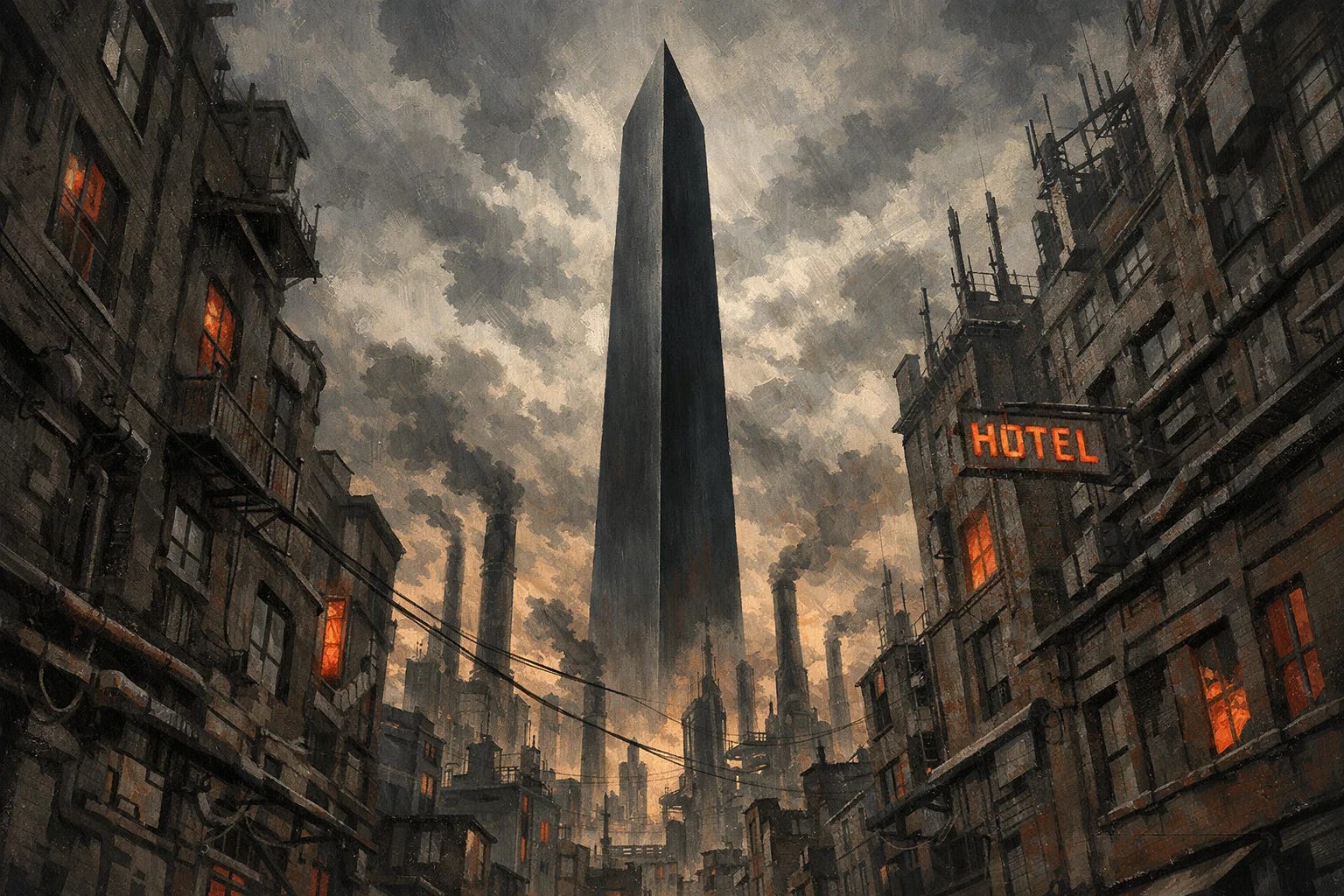
It took Verse hours to trail the Boss from the old lev-cutter out to Old Town, but his goons were uncooperative. They broke too quickly to tell her much, and, with the blood seeping still from the swiftly-bandaged wound on her side, she did not have long. At last, she stood on the rooftop of a brick building squatting in the shadows of countless others, and she looked down upon a monorail station in the trash-choked ruins of this old and defunct district. This part of the city was a sharp ascent of buildings, brick tenements and factory behemoths built between the Obelisks which helped give them purpose and efficiency. One such Obelisk occupied the skyline, blighting the smoggy-blue tones behind it with its sharp-angled blade of jet-black. It was the size of a building itself, but contained no rooms. She wondered, fleetingly, if it, too, was defunct—if a Logic Column such as that served any purpose in a part of the city which no longer had a purpose.
But Verse did not make a habit of wasting thought on unimportant things. She descended a fire escape, climbed through refuse-strewn rooms, passed over-crowded halls and drunken denizens, until she came to street level and strode toward the monorail. The streets of Old Town were mostly empty, as few here owned cars and fewer from other districts dared to drive here themselves. But that was not to say the streets had no cars; empty shells, burned out and looted, were littered all about, and graffiti spiralled from walls, to street, to road itself beneath the gaze of torn advertisements and broken windows. The apocalypse came to Old Town a long time ago, and everyone feared the next millennium would bring the same to the rest of the city. But Verse did not believe this. No, it would be worse.
She hopped a fence and grit her teeth against the pain, then carried on. The area was condemned, but had not been locked down in any meaningful way, and so she strode on without regard and passed countless old posters as she did.
Interested in blood-letting? Take the course.
The Authority is always watching. Report anomalies to your nearest Expulsions Officer.
Do interplanar forces seem to follow you? Does every house you move to seem to be haunted? Register with the Conceptual Manifestations Commission right away. It’s the law.
Authority of Dimensional Stability: Always Vigilant, Always Watchful, always here for YOU.
Celebrate the new millennium with the all-new Repeller Field™ from Spirit Ward®. ADS approved and ready to keep your home safe, even from Entropic Mass Transversal events!
She came to a halt at the entrance, which was boarded over and plastered in warning signs from the ADS. Local stability, it seemed, was unreliable. But Verse only smiled and hefted her sledgehammer. A few good swings sent the construction toppling and left the entrance open. She paused a moment to touch her side, but the blood had hardly slowed. She had less than an hour, she suspected, and so fished for her final cigarette and lit it up. She reflected blood-spattered in the amber glow, her mask like eyeless death.
Not much further now.
A peal of laughter left her lips beneath the roar of buck shot. One head exploded in a shower of gore and bone shards, blinding the man behind and sending the next, screaming, in search of cover. But Verse shouted her exertion behind a Yellow comedy mask and swiped with her bat, taking the legs out from under one even as she shot the next. Her sawed-off double-barrel had run dry, but she let it fall in favour of a double-fist grip on the base of her Louisville Slugger. And down she cracked it off a panic-stricken face, breaking nose in one hit, head on the next, until, at last, with spattering blood and a hollow thwack, she split the skull and left her signature as always.
She was taken by this sight enough to chuckle, but also enough to miss a glimpse of movement; she did not miss, however, the muzzle flash which quickly followed. A shot lodged itself in her gut, to the left side, and she yelped and dodged around a column for cover. Verse was in the depths of the monorail platform, having crept her way around the perimeter and dealt with the guards who’d barred her path. Her shotgun was far away now, she realized, and the gunfire which saturated her column indicated more than one foe awaiting her. Very well, then. She slung her bag from her back, wincing at the sting in her side, and ignore the alarming river of red which steadily streamed down her thigh. The bag was filled with improvised lengths of pipe tipped with simple fuses, and the first she lit with a pained chuckle and a cheap yellow lighter.
One bomb, then another, and with a series of flashes and cracks—screams and groans—she sensed her time was right. She lunged from cover, swiped up her shotgun, and reloaded. There was still some distance to go before she found her target. There were still some corpses who had yet to realize they were dead. She would gladly help them along.
Verse snapped a man’s neck and let him fall, paying no mind this time to the noise he would make as he fell onto the monorail tracks. She had left a quiet trail of bodies thus far, had crept from shadow to shadow as she lunged from the dark, and now, as she cast a long shadow past a burning barrel and darted behind a column, she would no longer make any attempts at subterfuge. She was close now—her target lay in the depths of this station, of that she was certain—and so it was a simple matter of cutting through the chaff. In blue and silver, she was a phantasm of death that emerged behind a trio of gangoons alerted to the body of their fallen comrade which had landed on the tracks nearest them.
The first she seized around the neck, and, jamming the barrel of a machine pistol against his temple, she silenced him before he could scream. To one side she hauled him, against a column for cover, and as his allies debated she turned her pistol on them and fired. The second was down in an instant, the third, spinning, fired blind from a shotgun and blasted into the first in place of Verse herself. She chuckled beneath the roar of her own rebuke and took him with three rounds in a burst, cleaving tooth and eye from skull and dropping him onto the tracks just like his friend. The last she hauled against the column, cracking forehead off concrete, and spinned around to face the threefold bite of her pistol. He dropped as well, and the way was clear.
Or so she thought. As she made for the stairs to the lower levels, a flash and roar told of the bullet which streaked through the darkness and caught her in the gut—on the left. She gasped and fired blind, then darted into the dark of a still and forgotten monorail car. More voices shouted in alarm, having emerged from some corridor she missed, and she cursed herself. It was careless, she thought, but the damage was done: blood streamed down her thigh, and the wound was deep. She knew well that she would not have long.
Her loud and unrelenting ferocity was something no Serpent ganger could’ve foreseen, and Verse took full advantage. She cut and shot her way down a half-dozen halls, through a half-dozen monorail cars, until at last she fired the terminal round from her revolver and bust into fragments the head of the man who had fired upon her. But she did not halt to reload, nor slow in her advance, and as gunfire flashed from the bottom of the stairs she charged on screaming. Her knife was over half a foot of jagged and polished metal, greased in the blood of a dozen men, and shined its menace as a submachine gun barked its fury and died beneath the wails of the berserker who fell upon its owner.
Verse leapt the last flight, a streak of red leather and blood-slathered flesh, and collided with the man who opposed her. He screamed and kicked as she fell upon him, struggled and thrashed as she stabbed and slashed, but with a down-stroke she took his fingers, with another sliced his jaw, and with a blood-maddened howl she pierced his throat and turned his screams to gurgles. Like this she mauled him—a burst of animal cruelty so immense as to send the other men—two with weapons trained on her—screaming and fleeing down the corridor instead.
At last, and at length, the man beneath her moved no more, and so Verse rose and growled between grit teeth. She was a charnel figure crowned with a rabbit’s countenance, and yet she was in this way more a rabid beast than a gentle thing of prey. And it was in this state, dripping with the blood of her devoured foes, that she noticed a sting in her left side. A river of red flowed down her thigh, proving to the small and rational part of her mind that her defeated foe had struck true and struck terribly. She was dying, but the beast did not care. The beast wanted blood, wanted more.
And she would get it.
The Boss was in the depths of the maintenance tunnels when he heard the terror of his men. Sweat beaded on his brow, but he kept his cool before the stricken faces of those he had on guard. Verse was coming. A cleaner was coming. He had faced many before, killed each one himself, but this one was the only one he ever feared. She had never failed to ice a target, and no one had ever dealt her a wound anywhere close to mortal. She felt like a force of nature, this Verse, though he had never met her, and he felt, as so many did in his age, that all things were coming to an end.
But that was why he was here. In the middle of the wide and shallow room, this place of graffiti-tagged concrete and age-rotted electronics, in this place of decay left forgotten beneath the palimpsest of the 20th century, they would buy humanity time. In the middle of this room were four figures, each robed in white, with their hands raised and voices synchronized in chant. The air was thick and charged, a sensation like cobwebs over his skin, and the presence of wavering candle light unnerved him. But he must remain here, and he must delay Verse. All his life, the Boss had been a monster—he done terrible things in the name of distraction, of pleasure, of indulgence, of survival. But, in the end, he realized it was really only fear which drove him. Fear was all he ever had; fear of death; fear of the end; and he had always believed that the end would find him no matter what. So, he hid—in women, in drugs, in violence, in power. All of these things were protections against the one thing he could not overcome, the enemy he could not crush: the end. Death.
But this was no longer true. As the blood of twelve corpses, freshly killed, began to shiver and raise from their bodies—coalesce on the ceiling within an otherworldly and crimson glow—he knew he was doing the one, and only, good thing he had ever done. He hefted a light machine gun into his arms. It was December 31st, 1999, and the world would end at midnight.
But not if he had his way.
THREE
CROSSROADS
For at this end an ending all
and ever here beginning all
Verse in black shot a leg and cracked a head, a hammer off a temple then a shot resounding through the dark. Another dropped as she advanced, until she passed toward a doorway and halted there in preparation. She heard voices from beyond and dared a glance, receiving a high-calibre round loosed for her trouble. It bit a hole clean through the concrete, and left no illusions about what it would do to her.
“I know why you’re here!” came a man’s voice. “And you’re making a mistake!” Verse did not answer, but instead laid down her hammer against the wall and checked her ammunition. Her pistol had run dry, so she sheathed it in favour of a submachine gun near her feet. “You want my head!” the man continued, and the fear in his voice was as palpable as enticing. “And I’d almost let you have it, too, bitch. But there’s too much at stake here to jeopardize it now.” When she said nothing still, he chuckled. “Woman of few words, huh? Fine by me. I was never much of a talker.”
She heard the heavy movement of his weapon and reacted instantly. Verse flattened herself low as a stream of gunfire roared her direction, tearing through the concrete wall that separated them and blasting craters into the one beyond. Dust and shrapnel leapt high and saturated the air, whirling in chalky clouds as the wake of his monstrous assault canon streaked left and right. But Verse was not phased, for death was something she never feared. And so she crawled beneath the concrete smog, lost in the dark and the dust, until she could angle herself into view of the Boss. He wore heavy ballistic gear, she realized, and she only had a magazine with which to shred it.
Her shots had better count.
Verse in Yellow had blasted her way to the depths of the monorail station, but there was no laughter as the Boss opened fire. Her bag was empty, not a bomb left to shred him, and she ducked and weaved as she made a final lunge into the room with the hope of ending him. Two shots resounded from her double-barrel, but too late she realized the military gear with which he’d been outfitted. Her shots shredded weave and stuck in plate, reaching not their target as he turned about to fire. She had a moment to consider that his gear was advanced—that it was beyond the scope of a mere street gang—and that it was marked on a shoulder pad by the triangular symbol of the ADS, before a peal of 50-calibre gunfire rent her body to bloody ribbons.
Verse in Blue, so worn by the foes who had ambushed her, was forced into a corner as she emerged into the basement room. Her lithe agility and subtle alacrity brought her near enough to the Boss, and past his goons, as to almost strike a killing blow, but in the end, against such heavy armour, she lacked the means to truly stop him. A fist cracked a goon’s skull, a spray of shots riddled the other, but as she wrestled with the LMG, fired point-blank into his ballistic vest, she found no strike could truly harm him. He threw her back and struck her with his weapon, then levelled a kick so vicious as to throw her against the wall. In her disorientation, she glimpsed, for the briefest moment, an eldritch ritual and a great heaving, rippling mass of anomalous energy.
And then he blasted her head from her shoulders.
Verse in Red made the least distance, for her rage and abandon earned her nothing. Two rounds were embedded in her chest as she sliced one goon, another found her gut as she butchered the next, and when she came scrambling, stumbling, into the the chamber beyond, the Boss was ready. She rushed some feet toward him, howling as a feral animal, and was cut down by three rounds which burst and opened her blood-soaked flesh in vibrant blasts of scarlet.
And yet, even as she fell, she hissed and gurgled, knife clenched and readied. He came to stand over her, eyes wide and horrified even in his victory, as the monster beneath him struggled still to eviscerate her enemy. He swallowed, levelled his weapon, and shot her into oblivion.
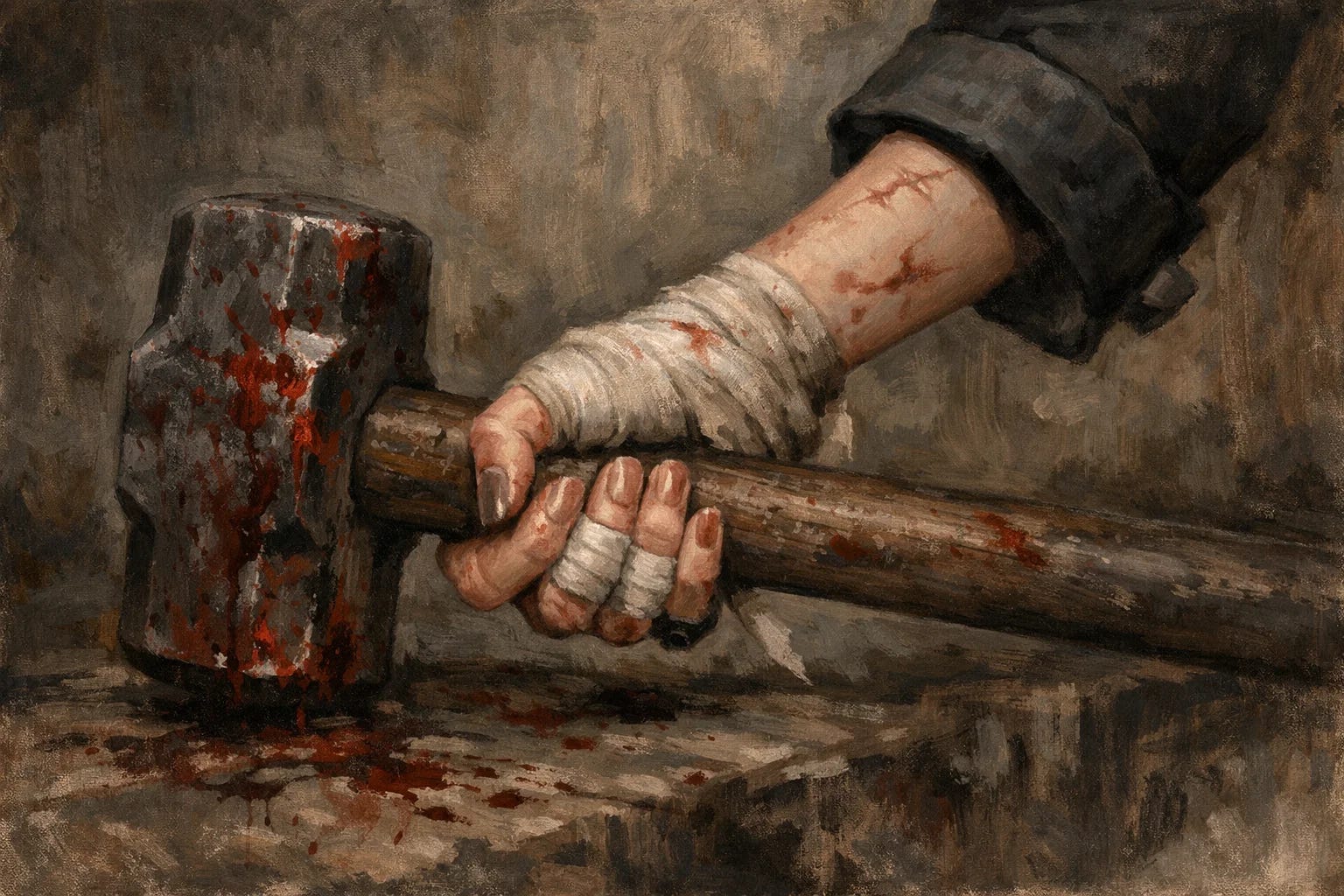
Verse in Black crawled prone until, without even the faintest of warnings, she opened fire in full-auto. A storm of gunfire streaked up the Boss’ exposed flank, bypassing the strongest of his armour and biting deep into the flesh beneath. He screamed and stumbled, his gunfire disrupted, and in that moment Verse leapt to her feet and charged. With hammer aligned she struck him hard against the breastplate, launching all air from his lungs as he crumpled and staggered. And so she swung about, whipping with the momentum until she struck him across the helmet and cracked the ballistic glass there attached. She swung again and met his chest—again and dented his helmet—and at last, on a final swing, she cracked her hammer off his hand and forced him, howling, to drop his LMG. It skittered aside some distance, leaving him no better option.
He threw up his arms and blocked the next strike, wrapping his hands this time around the haft of her weapon, and with a mighty pull he drew her toward him and thrust out a foot. His boot met with her wounded gut and she folded, losing all breath as she tumbled to her back and rolled with the fall. Her roll brought her to a crouch promptly, but sent her cigarette falling in the process. Blood streamed anew from her agitated wound, and her mind began to swim. She was close—both to her prey and to her death—and she vowed, as she watched him struggle and recover, toss her hammer aside—that she would insure he went first. The chanting nearby had risen to a greater chorus, and the energies in the room had grown more powerful; Verse had seen anomalies in her life, everyone had, but never quite like this. The very air—or perhaps the stuff of reality itself—began to ripple, and a strange, reddish glow took prominence as the exsanguinated corpses in the centre of the room rose by invisible force and began to tangle and fuse together. She wondered where the Authority was, why they were not here to intervene, but these thoughts were second only to her true and dominant one: blood. She eyed the LMG, and so did the Boss. The objective was clear, the result assured. Now she would act.
Verse leapt to her feet and raced for the weapon, arriving simultaneously with her foe and offering a feint. She went at first for the weapon, and he attempted to lunge and grapple her to prevent this, but at the last moment she weaved and came to leap onto his back and grapple him instead. Her hands found his helmet and ripped it off promptly, then, throwing her weight against him, she pulled him back and away from the LMG in time for the chanting to grow more fervent. Black-painted nails clawed at his eyes, at his neck, and forced a pained shout as he reached behind him and took her by the hair. Like this he hauled her over his head and threw her to the ground, making next to drive his fist into her face.
But she thrashed and turned with serpentine agility, tearing her wound yet further even as she shot a foot out to meet his face and broke his nose. He roared and staggered, allowed her to roll and slither away, and in this barest break in melee she lunged for the LMG and brought it up to bear. But he too lunged for her and brought his hands around the weapon, turning it away even as it disgorged three rounds across him. One tore his shoulder pad clean to pieces while the next, skimming by, struck a white-robbed conjurer in the head and dropped him instantly. The others, mortified, did not halt in their chanting, merely moving to cover his space in the hope that their ritual was not interrupted.
And thus Verse struggled with the Boss for dominion over the only weapon that could kill him. But, despite her strength and cold resilience, he was stronger still. He forced the weapon, gradually, around to face her, pushing her to her back even as she struggled. He came nearly to straddle her as the barrel slowly turned toward her head, and, as the loss of blood at last began to truly reach her brain, she felt a tunnel of darkness press in around her. A good death, she thought, even if she lost. She glanced to one side, catching a glimpse of amber in the corner of her eye, and saw her cigarette, still smouldering, within reach.
But Verse was never one to lose. She snapped out a hand and snatched her cigarette, then thrust its burning tip toward the Boss’ face and gouged his eye. He screamed, shocked, and pulled back just enough to allow her the chance she sought. She shoved the LMG forward, pressed against his chest and angled skyward, then fired full-auto—blasting his head clean into bloody fragments and embedding its shards in the concrete above.
The Boss dropped dead, allowing Verse, breathless and weary, to struggle to her feet. The chant had continued unabated all the while, and now, as she turned to regard it and felt the hairs raise on her neck, she knew somehow that she was too late to stop it. The red glow rose and the walls seemed to melt—seemed to ripple and become molten—as the floor beneath her twisted and spiralled. She lost her balance and stumbled forward, falling on her hands and knees at the edges of a ritual circle painted in blood on the floor. The conjurers cried out in unison, screaming with such horror and extremity as to reach something deep within Verse, something quiet and sequestered, and to draw from it a terrible, animal fear. And then their eyes burst from their skulls, their ears and noses bleeding thick streams of black ichor as they convulsed and squealed. All seemed to rise in a terrible chorus of horror and change until, at last, the conjurers turned their heads upward in unison and spoke simultaneously. Their words were strange, slithering syllables Verse had never heard before, and their very nature made her skin crawl and head throb.
Phrases rose in rhythm from their mouths, something almost like poetry, before their voices became a cutting drone and Verse, too weak to move, felt her body suddenly lift. She was raised by invisible force until she came to levitate over the circle, the corpses beneath her now arranged—fused by some unnatural means—into a macabre series of geometric lines interconnected with one another. Blackness rose about her suddenly, filling Verse, for the first time in her life, with such a primordial fear as to make her scream aloud. For she did not fear death—never had she, nor did she then—but it was not death that faced her.
It was something worse.
FOUR
CONVERGENCE
A loop is closed by Four and Twelve
forever sealed without resolve
Verse in Black stood in nothingness, and could see only herself. She had died—or so she hoped—and this, whatever it was, must be what came after. A kind of Hell, she was beginning to think, and perhaps a place fitting for a creature like her. But it was at these thoughts that there came a change, a shape emergent in the dark, which turned to meet her eye. It was a woman in white and Yellow, a tank top and comedy mask, who regarded her with a cocking of the head. Another shape shortly emerged, this a woman in Blue who wore leather and spikes. A third emerged thereafter, who wore a red jacket and showed bare chest without regard. These four knew one another, and yet did not understand.
It was only Black who, recalling her musings on time, wondered if she had been right all along: from one worldline, to the next. But she could not ask the others, for a sudden sense of weightlessness afflicted them all. They felt as though they were falling, and Black, losing sight of the others, dropped backward and hit something hard.
She jumped and took in her surroundings: a familiar apartment, a filthy carpet, and a mattress from which she had fallen. Black rose, finding herself half-naked, and strode across the room to a window. The smoke and concrete of her city sprawled forth as ever, dusted now with a flurry of greyish snow, and seemed to spin the gears of industry as always. And yet, if she had somehow survived her hunt, it should be January 1st 2000. The world should’ve ended.
Verse moved into another room, where a bulky laptop lay in wait, and powered it on. The date in one corner read January 1st, 1999. She blinked, then checked her side. No wound was to be found, and she was most certainly alive. But there, too, was something changed about her—something subtle which had taken residence in the back of her skull, in the tip of her spine. Verse was always alone—had always been alone—and yet just then, as she rubbed the back of her head, she felt the strangest sense of company. There were three others, she thought. Perhaps she could find them. No, came a thought, she must find them. It was a compulsion, not a choice, and she wondered at its origin.
The ritual had been a success, of that she was certain. But who were they? What had they done? What will they do? She crossed the room and found a bra, then began to dress in earnest. What had she interrupted? Could she have stopped it? She slipped her black sweater over her head, then found her mask. And who were these others? Were they her, or something altogether different? In the end, a cold certainty settled into her eyes, and that serpentine precision which so often coloured them returned to their dark recesses. She had been promised a death—the world had been promised a death. But this was taken from them. She could not allow it. Verse found her sledgehammer. Everything had its end.
She felt her hand along the haft of her signature, then hefted it onto her shoulder and lit a cigarette.